Most small factories do not have a supplier shortage. They have a supplier-decision problem.
A purchase request starts on WhatsApp. Three vendors quote in three formats. The lowest number gets attention. Delivery dates are remembered, not recorded. Material reaches the gate, but stock changes only when somebody enters the bill.
The fix is not “buy procurement software.” The fix is to route each purchase through the right process.

The 60-second decision
Before searching for a supplier, classify the requirement.
| Ask this first | If the answer is yes | Use this route |
|---|---|---|
| Do we know the exact brand, model, or standard specification? | The buying risk is mainly price, availability, and delivery | Catalog marketplace |
| Can a wrong supplier create rejection, downtime, or repeat quality issues? | Capability matters more than the number of leads | Assisted sourcing |
| Does somebody need to own production follow-up, QC, documents, and logistics? | The purchase is an execution project | Managed sourcing |
| Has the supplier already been selected? | The remaining problem is internal control | Manufacturing ERP |
Do not send every requirement through the same channel. An M6 fastener and a tight-tolerance machined housing are not the same procurement job. Treating them alike either wastes time or increases risk.
The sourcing stack at a glance
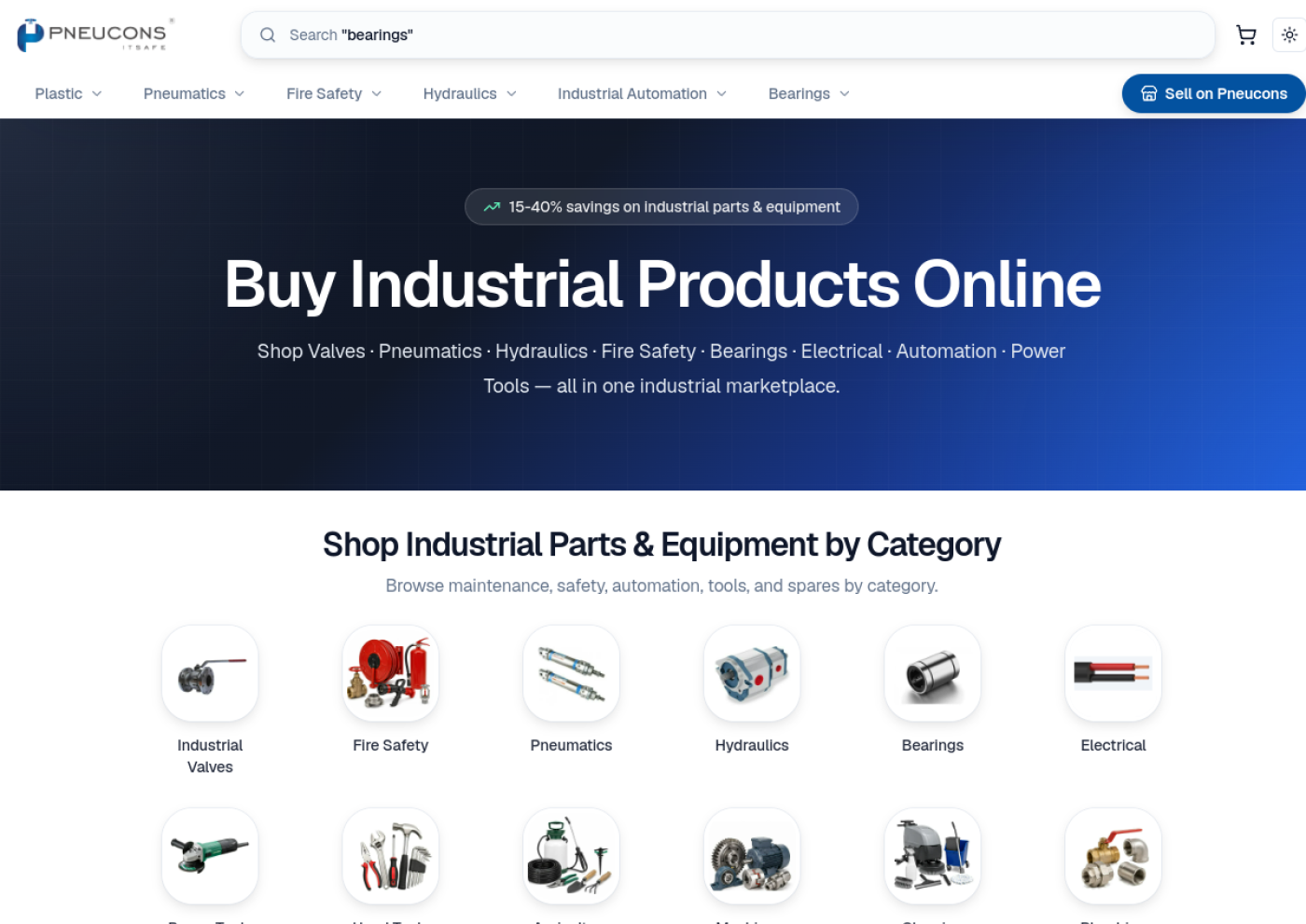
You already know the brand, model, part number, or standard specification.
What you get
Compare catalog options and buy from an industrial seller.
The supplier’s machinery, process capability, or certification can make or break the order.
What you get
Receive a focused, human-reviewed supplier shortlist.
 Procurio
Custom production, QC, documentation, and logistics need one accountable owner.
What you get
Run the requirement through a managed sourcing pipeline.
 FactoStack
The supplier is selected; now the PO, receipt, stock, BOM, and production must stay connected.
What you get
Control the internal purchase-to-production workflow.
These products do not need to be technically integrated on day one. The hand-off can be simple: once a supplier and price are approved, create the purchase order in FactoStack and make that PO the internal source of truth.
Lane 1: Standard MRO and known parts
Use a marketplace when your team can describe the item without a technical discussion:
- SKF 6205-2RS bearing
- 1/2-inch pneumatic solenoid valve with a known voltage and port size
- A named model of power tool
- Standard fire-safety equipment
- A repeat-purchase electrical component
Pneucons is built around industrial catalog search. Its categories include valves, pneumatics, hydraulics, bearings, electricals, automation, power tools, safety products, and other MRO lines.
What to check before ordering
Do not compare only the displayed price. Put these fields side by side:
| Field | Why it matters |
|---|---|
| Exact manufacturer and model | Similar-looking industrial parts are not always interchangeable |
| Seller named on the invoice | Establishes who is responsible for warranty and tax documentation |
| GST and freight | Prevents a cheap unit price becoming a higher delivered price |
| Dispatch date, not “in stock” | “Available” does not always mean ready to ship |
| Warranty and return terms | Critical for electrical, pneumatic, and rotating equipment |
| Certificate requirement | Ask before ordering if test or conformity documents are needed |
Use Pneucons when: the specification is settled and your team is comparing availability, seller, price, and delivery.
Do not use a catalog-only route when: the application itself needs engineering judgement.
Lane 2: Critical parts where supplier fit matters
Consider a pump requirement: fluid, viscosity, temperature, flow, head, duty cycle, seal material, and motor specification all affect the choice. “Need industrial pump, send best price” is not a usable RFQ.
Menerix starts with a structured requirement. Its team reviews application context, specifications, volume, timeline, and past problems before shortlisting suppliers. The stated output is three to five relevant suppliers rather than a large list of contacts.
Menerix’s useful constraint: the process begins with application context, technical specifications, volume, timeline, and previous problems. That is the information a serious supplier needs before offering a defensible quote.
Build a requirement pack before asking for quotes
Technical
Drawing and revision, material grade, tolerances, finish, application, mating parts, inspection points, and approved deviations.
Commercial
Prototype quantity, batch quantity, annual quantity, target date, delivery location, payment expectation, and packaging.
Supplier capability
Machine list, process ownership, subcontracted operations, relevant past parts, capacity, certifications, and inspection equipment.
Known risk
Previous rejection reason, field failure, delayed operation, drawing ambiguity, or process that has caused trouble before.
A practical supplier scorecard
Do not let the lowest quote automatically win. Score each shortlisted supplier out of 100:
| Criterion | Weight |
|---|---|
| Technical and process fit | 30 |
| Inspection capability and quality record | 20 |
| Delivered price | 20 |
| Lead time and available capacity | 15 |
| Relevant references or past work | 10 |
| Communication and documentation | 5 |
For a breakdown-critical component, move more weight from price to quality and delivery. For a simple repeat component with three proven vendors, price can carry more weight.
Menerix reduces supplier-selection risk; it does not guarantee execution. Your PO, drawing control, inspection plan, and acceptance criteria still matter.
Lane 3: Custom parts that need managed execution
Some purchases are not finished when the supplier is selected. They need weekly production follow-up, inspection evidence, packing control, export documentation, freight coordination, and one party accountable for the whole movement.
Procurio positions itself as a managed sourcing company for large overseas OEMs buying industrial supplies from India. It handles standard and built-to-drawing parts through supplier selection, production oversight, QC, documentation, and logistics.

When the managed model earns its fee
- The buyer is outside India and does not have a local sourcing or quality team.
- Parts are made to drawing and require production-stage follow-up.
- Pre-dispatch inspection and a documentation pack are mandatory.
- Several Indian suppliers must be consolidated into one shipment.
- The landed cost matters more than the ex-works unit price.
- A missed batch can disrupt an OEM launch or export commitment.
For a domestic MSME buying locally, this model can be excessive for routine parts. It becomes relevant when you are supplying an export programme, developing a complex custom part, or need an external team to own QC and logistics.
Put these terms in writing
- Drawing revision and who can approve deviations
- First Article Inspection or sample approval
- In-process and pre-dispatch inspection points
- Measurement report and material certificate format
- Treatment of rework, rejection, and replacement freight
- Incoterm, packing standard, insurance, and landed-cost inclusions
- Ownership and confidentiality of drawings, tooling, and process data
The hand-off most factories miss
Supplier discovery ends when the vendor and commercial terms are approved. Factory control begins immediately after.
Material shortage
MRP or a production order shows what must be purchased.
Supplier approved
The team confirms technical fit, quotation, and delivery promise.
Purchase order
Price, tax, quantity, revision, and promised date become a controlled record.
Material received
Stores records the quantity that physically reached the factory.
Incoming inspection
Material is accepted, rejected, or held before it becomes usable stock.
GRN and inventory
Accepted quantity updates the correct warehouse or bin.
BOM consumption
Production issues material against the actual job or batch.
Dispatch and invoice
Finished output moves through dispatch and GST-ready invoicing.
If the first three steps happen on a sourcing platform but the rest remain in a notebook and WhatsApp, the business still cannot answer:
- What is due this week?
- Which supplier is late?
- Did we receive the full PO quantity?
- Was any material rejected?
- Is accepted stock available for this production order?
- Did production consume the planned quantity?
- Does the supplier bill match what the gate received?
Where FactoStack fits
FactoStack does not compete with the three sourcing routes above. It closes the internal loop.
Procurement and Purchase Order Management
Track purchase orders, expected deliveries, GRNs, discrepancies, and vendor follow-up in the same system as inventory and production.
The working process
- Material requirement: A production order or MRP run identifies the shortage.
- Source externally: Your team uses Pneucons, Menerix, Procurio, or an existing approved vendor.
- Approve internally: Record the selected vendor, price, tax, quantity, specification, and promised date on the PO.
- Receive against the PO: The gate or stores team records the actual quantity received.
- Inspect: Accept, reject, or hold material instead of treating every delivery as usable stock.
- Create the GRN: Accepted quantity updates inventory at the correct location.
- Consume through the BOM: Production issues material against a production order, preserving planned-versus-actual consumption.
- Hand off to accounts: Purchase and invoice details stay available for the accounting workflow while your CA continues using Tally.
The sourcing tool answers
Who can supply this item? Does the supplier fit? What will it cost? Who owns sourcing execution?
FactoStack answers
What did we order? When is it due? What arrived? What passed inspection? Where is it in stock? Which job consumed it?
A four-week implementation plan
Week 1: Classify spend
Export or write down the last 90 days of purchases. Tag every line:
- A — Catalog: known brand, model, or standard specification
- B — Capability: supplier process and technical fit must be checked
- C — Managed: custom execution, QC, documentation, or logistics needs an owner
Do not aim for perfect spend analytics. You need enough data to see which lane carries the most purchase value and which creates the most disruption.
Week 2: Standardise the RFQ
Create one RFQ template containing:
- Internal item code and description
- Drawing number and revision, where applicable
- Quantity and unit
- Required delivery date and location
- Inspection and certificate requirements
- Tax, freight, packing, and payment fields
- Quote validity
Stop accepting a final quote that only says “as discussed.”
Week 3: Make the PO the control point
Every approved purchase gets a PO before material arrives. Attach or reference the selected quote, drawing revision, and inspection requirement. Record the supplier’s committed date.
This is the point where external sourcing becomes an internal obligation.
Week 4: Make GRN update stock
Do not increase usable inventory when a truck enters the gate. Increase it when the received quantity is checked and accepted.
Track three numbers separately:
- Ordered quantity
- Received quantity
- Accepted quantity
That distinction exposes short supply and rejection instead of hiding both inside a single stock figure.
FactoStack
See the full purchase-to-production flow
Bring one recent PO and one BOM to a FactoStack demo. We will map how the material moves from shortage to GRN, stock, and production consumption.
What good looks like after 30 days
You do not need an AI procurement command centre. You need operational answers without calling four people.
- Standard items take fewer calls to source.
- Critical RFQs carry enough information for suppliers to quote correctly.
- Custom orders have named inspection and delivery ownership.
- Every approved purchase has a PO and committed date.
- Stores receives against the PO, not against memory.
- Rejected material does not appear as usable inventory.
- Production can see what is actually available.
- Accounts does not recreate the transaction from a paper bill.
That is a smarter sourcing stack: the right buying route for the requirement, followed by one controlled internal workflow.
FactoStack
Start with one real purchase order
Try FactoStack for 14 days with your existing vendors, items, BOMs, and purchase workflow. No need to replace Tally.

Written by
Sudharsan GS
Building FactoStack with Indian MSME manufacturers across inventory, production, dispatch, GST, and Tally workflows.