A factory can finish production on time and still miss the delivery date.
The goods are ready, but cartons are unavailable. Labels are waiting for customer approval. Quality has not released one batch. The vehicle arrives before the invoice is prepared. Nobody is sure whether the customer approved a partial shipment.
This gap between production complete and shipment handed over is where many delivery promises break.
Packaging and dispatch need their own visible workflow, connected to the sales order and finished-goods stock.
Production Complete Does Not Mean Ready to Dispatch
An item may be physically manufactured but not yet shippable.
It may still need:
- final quality clearance
- cleaning or finishing
- primary and secondary packaging
- customer-specific labels
- batch, serial, or date marking
- counting, weighing, or palletisation
- invoice and transport documents
- vehicle planning
If the system uses only a single finished status, sales assumes the order can ship while the dispatch team knows several tasks are still open.
Use separate milestones such as:
- production complete
- quality released
- ready for packing
- partially packed or packed
- documents ready
- vehicle assigned
- dispatched
- delivered or proof received
That makes the true order position visible to everyone.
Start With the Customer Order
Every packing and dispatch record should link back to the sales order line.
The order provides the baseline:
- customer and delivery address
- item, specification, and revision
- ordered quantity
- promised date
- customer purchase-order reference
- packing and labelling instructions
- whether partial dispatch is allowed
- delivery slot or transporter requirement
Without this link, dispatch may ship what is available rather than what the customer actually asked for.
A Practical Packaging-to-Dispatch Workflow
1. Build the dispatch-ready queue
Create a view of order lines that have cleared production and quality. Show their promised dates, available finished quantity, packing status, and blockers.
This queue helps the dispatch team prioritise by customer commitment instead of waiting for last-minute phone calls from sales.
2. Reserve the finished goods
Allocate a specific quantity, batch, lot, or serial range to the order. Reservation stops the same stock from being promised to another shipment.
For traceable products, record exactly which batches or serials are packed for the customer. This becomes valuable later if there is a complaint or recall.
3. Create the packing plan
Define how the quantity will be packed:
- pieces per carton, bag, drum, crate, or pallet
- number of packages
- gross and net weight
- package dimensions where freight depends on volume
- packing material required
- label template and customer markings
If packaging material is a stocked item, deduct actual consumption. Cartons, liners, labels, tape, and pallets affect both readiness and product cost.
4. Verify packed quantity
The quantity packed may differ from the quantity planned. Record the actual count or weight before documents are finalised.
For example, an order for 5,000 pieces may have 4,800 pieces quality-released and only 4,600 packed before the vehicle cutoff. The system should show:
- ordered: 5,000
- previously dispatched: 0
- packed now: 4,600
- dispatching now: 4,600
- balance: 400
Do not close the full sales order because one shipment left the gate.
5. Prepare and check documents
The documentation depends on the movement, but the dispatch record should keep the relevant references together:
- tax invoice
- e-way bill, where required
- delivery challan, where applicable
- packing list
- transporter docket or LR number
- vehicle number
- customer PO reference
- export or customer-specific documents, when relevant
The goal is not to duplicate accounting. It is to make document readiness part of shipment readiness.
6. Record gate handover
Capture the actual dispatch time, transporter, vehicle, package count, and who handed over the goods. Attach or record proof such as a signed gate pass, LR, or transporter acknowledgement.
Only then should finished-goods inventory reduce and the shipment status become dispatched.
Release
Production and quality confirm which finished quantity is available for dispatch.
Reserve
Allocate the right lot, batch, serials, or stock to the customer order.
Pack
Record actual packages, quantity, weight, packing material, and labels.
Document
Prepare invoice, transport references, packing list, and required movement documents.
Handover
Capture vehicle, transporter, time, proof, and reduce the dispatched stock.
The Dispatch Board Your Team Actually Needs
A useful board shows orders by stage and exception:
| Order | Promised date | Ready qty | Packed qty | Dispatch qty | Blocker |
|---|---|---|---|---|---|
| SO-1842 | 6 Aug | 2,000 | 2,000 | 2,000 | Vehicle at 4 PM |
| SO-1847 | 6 Aug | 1,200 | 900 | 900 | Partial approval received |
| SO-1851 | 7 Aug | 5,000 | 0 | 0 | Labels pending |
| SO-1854 | 8 Aug | 750 | 0 | 0 | QC hold on batch B-31 |
This makes the daily dispatch meeting short and specific. The team discusses blockers instead of reconstructing status from calls.
Handle Partial Dispatch Without Losing the Balance
Partial shipments are normal when production completes in stages, the customer requests urgent quantity, or vehicle capacity is limited.
Each dispatch should create its own record while remaining linked to the original order. Track:
- quantity in this shipment
- cumulative quantity dispatched
- balance pending
- reason for partial shipment
- customer approval, if required
- next expected shipment date
This protects sales from telling the customer an order is complete when a balance is still open.
Track Packaging as Material, Not an Afterthought
Packaging shortages can stop revenue just as effectively as raw-material shortages.
Include cartons, pouches, caps, labels, inserts, pallets, and protective material in planning where they are order-critical. For customer-branded packaging, maintain the correct version and approval status.
A packaging bill of materials can help repeat products consume the right quantities automatically while still allowing dispatch to record actual usage.
Dispatch Metrics Worth Reviewing
Avoid dashboards with dozens of numbers. Start with metrics that change behaviour:
- on-time dispatch percentage
- orders due in the next seven days but not dispatch-ready
- finished goods waiting for packing
- packed goods waiting for documents or vehicle
- average time from production completion to dispatch
- partial dispatch frequency
- quantity or packages corrected after final check
- proof of delivery still pending
These metrics show whether the bottleneck sits in production, quality, packaging, documentation, or transport.
Common Dispatch Failures and Their Fixes
The invoice quantity does not match the packed quantity
Generate or confirm the invoice from the final dispatch quantity, not an earlier plan.
Sales promises stock already reserved elsewhere
Use order-level reservation and show available-to-promise separately from physical stock.
The vehicle waits at the gate
Add document readiness and vehicle scheduling to the dispatch board before the planned loading time.
Labels or cartons arrive too late
Plan critical packaging material from confirmed sales orders and include its status in readiness checks.
Nobody can prove what was sent
Keep the packing list, batch or serial allocation, LR, vehicle, and handover proof against one shipment record.
Where FactoStack Fits
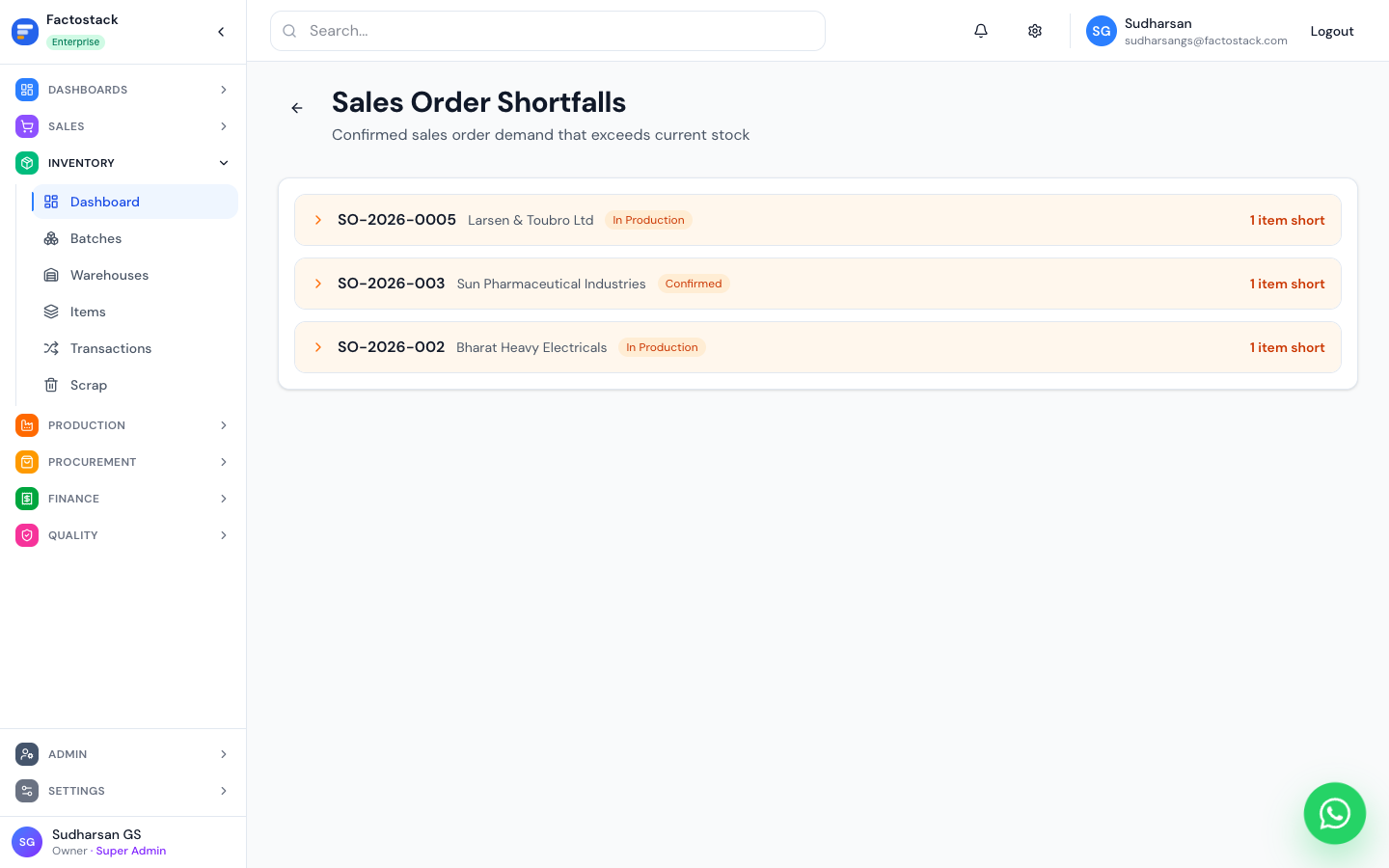
FactoStack connects sales orders, production status, finished-goods inventory, packaging, invoicing, and dispatch. Teams can see what is ready, what is packed, what shipped, and what balance remains without maintaining a second spreadsheet.
Order Fulfilment and Dispatch
Track customer orders from production readiness through packing, shipment, and pending balance in one operational flow.
Related Guides
- How to track WIP inventory in a small factory
- Production order vs work order
- How to track purchase orders, GRNs, and vendor payments
- How to digitise a small factory
Frequently Asked Questions
Treat Dispatch as the Last Production Stage
The customer does not experience your production completion date. They experience when the correct goods, documents, and quantities leave the gate and arrive as promised.
When packaging and dispatch are visible stages of order fulfilment, finished goods move faster, partial shipments stay controlled, and delivery commitments become easier to trust.

Written by
Sudharsan GS
Building FactoStack with Indian MSME manufacturers across inventory, production, dispatch, GST, and Tally workflows.