Every manufacturing conference in India now talks about AI, Industry 4.0, smart factories, and digital transformation.
The language sounds exciting. The demos look impressive. Automated quality inspection. Predictive maintenance. AI-powered demand forecasting. Digital twins of the shop floor.
Then the factory owner goes back to a unit where:
- production plans are on a whiteboard
- stock is tracked in Excel
- customer orders come through WhatsApp
- the accountant reconciles everything manually in Tally at month end
The gap between the conference stage and the shop floor is not a technology problem. It is a sequencing problem.
The Real Modernization Sequence
Most coverage of AI in manufacturing skips the foundational steps. Here is what the actual sequence looks like for an Indian MSME:
Stage 1: Get data into a system
Before AI can do anything useful, the factory needs structured data about:
- what orders are open and their current status
- what inventory exists, where it is, and whether it is usable
- what production is planned, in progress, and completed
- what was dispatched, invoiced, and paid
- what was rejected and why
If this data lives in WhatsApp messages, paper registers, individual Excel files, and scattered Tally entries, no AI model can work with it. The data is not just unstructured. It is inaccessible.
This stage is the actual bottleneck for 90 percent of Indian MSME manufacturers.
Stage 2: Build operational discipline
Once data is in a system, the factory starts building habits:
- orders are confirmed digitally before production starts
- material is issued against a production order, not informally
- GRN is recorded when goods arrive, not days later
- dispatch is linked to the invoice
- rejections are recorded with a reason
This is not technology. It is process discipline supported by software.
Stage 3: Use data for decisions
With 3 to 6 months of clean operational data, the factory can start asking questions like:
- which products have the highest rejection rate?
- which vendors deliver late most often?
- which customers pay the slowest?
- which items are overstocked?
- where is WIP getting stuck?
These questions do not require machine learning. They require structured queries on clean data. A well-designed dashboard answers them.
Stage 4: Apply intelligence
This is where AI becomes genuinely useful:
- Demand prediction. Based on order history, seasonality, and customer patterns, suggest production quantities.
- Material planning suggestions. Based on BOMs, lead times, and current stock, recommend what to order and when.
- Quality pattern detection. Based on rejection data, identify which machine-operator-material combinations produce the most defects.
- Cash flow forecasting. Based on receivable and payable patterns, predict cash position 30 to 60 days ahead.
- Smart reorder points. Based on actual consumption, adjust reorder levels instead of using static guesses.
Notice that all of these require Stages 1 through 3 to be complete first. AI without data is just guessing.
Digitize
Get core workflows into a system: orders, inventory, production, invoicing. Replace paper and scattered Excel.
Discipline
Build operating habits: confirm before producing, record before dispatching, inspect before accepting.
Analyze
Use 3 to 6 months of clean data to find bottlenecks, waste, and improvement opportunities through dashboards and reports.
Apply AI
Layer intelligent suggestions on top of structured data: demand prediction, smart reorder, quality patterns, cash forecasting.
What AI Can Actually Do for a Small Factory Today
Let us be specific about what is practical now, not in a research lab, but in a 50-person factory in Coimbatore or Faridabad.
Intelligent material planning
Instead of the purchase team guessing what to buy, the system can:
- look at confirmed orders and their BOMs
- check current stock
- factor in vendor lead times
- suggest a purchase plan
This is not sophisticated AI. It is basic MRP logic. But most MSMEs do not even have this running because their data is fragmented.
Automated invoice and GST compliance
- Auto-populate invoice from dispatch records
- Calculate GST based on HSN codes and customer location
- Generate e-invoice in the correct format
- Flag mismatches before filing
This saves hours of manual work every week and reduces compliance risk.
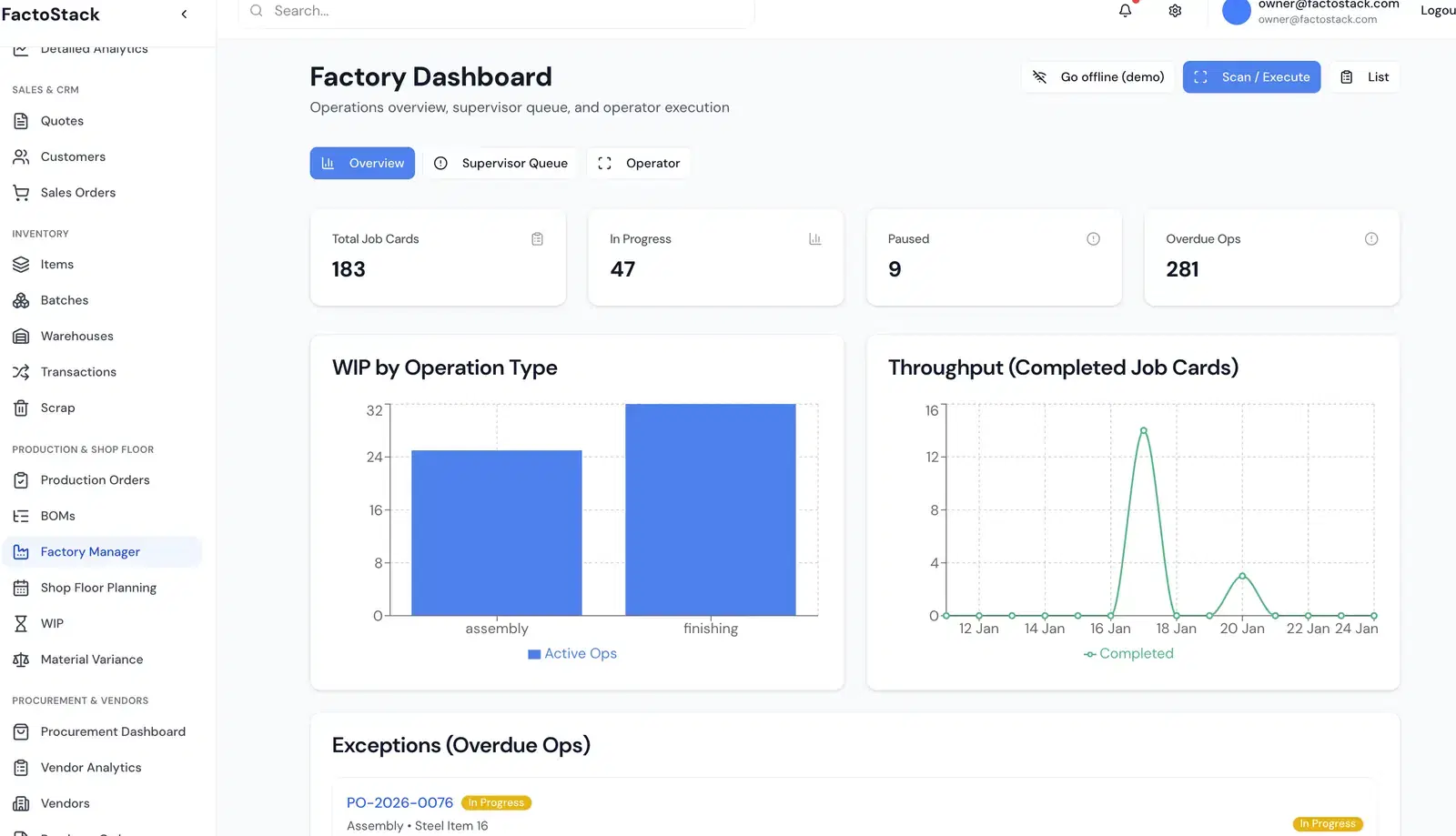
Smart alerts and exceptions
Instead of the owner chasing status updates, the system can flag:
- production orders that are behind schedule
- inventory items below reorder level
- invoices overdue by more than 30 days
- vendors who have not delivered on committed dates
- quality rejections above the threshold
This is AI in its simplest form: pattern matching on structured data. It is also the highest-impact application for most factories.
Document intelligence
AI-powered OCR and extraction can:
- read vendor invoices and match them against POs
- extract data from customer drawings or specifications
- parse delivery challans and update GRN records
This reduces data entry and catches errors earlier.
What AI Cannot Do (Yet) for Most MSMEs
Replace human judgement on the shop floor
A supervisor who knows that Machine 3 runs slightly different on humid days, or that a particular vendor's steel needs different speed settings, carries knowledge that no system captures yet.
Work without clean data
If the factory's stock numbers are wrong, AI will confidently suggest the wrong purchase plan. Garbage in, garbage out applies doubly to intelligent systems.
Solve organisational problems
If the factory owner's brother-in-law refuses to use the new system, or the accountant insists on keeping everything in Tally, AI cannot fix that. Adoption is a people challenge first.
Justify its cost for very small factories
For a 10-person factory doing Rs 1 Cr turnover, a Rs 50,000 per year AI subscription is hard to justify. But basic digitization at Rs 12,000 per year can transform operations. Start there.
The Indian Manufacturing Context
Factory modernization in India has specific characteristics that generic "Industry 4.0" advice misses:
Infrastructure reality
- Internet connectivity on the shop floor can be unreliable
- Workers use budget Android phones, not industrial tablets
- Power cuts are common in many industrial areas
- Most factories do not have IT staff
Software that works must be mobile-first, work on slow connections, and not require a server room.
Workforce reality
- Many operators are comfortable with WhatsApp but not with ERP screens
- Training time is limited because production cannot stop
- High turnover in some industries means retraining frequently
- The language of work is often Hindi, Tamil, Gujarati, or Marathi, not English
Software that gets adopted needs to be simple enough for minimal training.
Decision-making reality
- The owner makes most decisions, not a management team
- Speed of decision matters more than depth of analysis
- Cash flow is a weekly concern, not a quarterly review topic
- Family-run businesses have informal hierarchies that formal systems must accommodate
Scale reality
- Most Indian manufacturing MSMEs have 10 to 100 employees
- Annual turnover ranges from Rs 2 Cr to Rs 50 Cr
- Margins are tight, often 5 to 15 percent
- Capital expenditure decisions are conservative
This means modernization cannot require heavy upfront investment. It must deliver ROI within weeks, not years.
A Practical Modernization Checklist
If you are a manufacturer considering modernization, here is a realistic starting checklist:
Month 1 to 2: Foundation
- Choose one workflow to digitize first (inventory, orders, or invoicing)
- Clean up your item master (standardize names, units, HSN codes)
- Import customer and vendor lists
- Start entering new transactions in the system (keep old processes running in parallel)
Month 3 to 4: Expand
- Add production orders or work orders
- Connect procurement to production (BOM-based purchasing)
- Set up e-invoice and GST filing from the system
- Train 2 to 3 additional team members
Month 5 to 6: Optimize
- Review dashboards weekly: what is stuck, what is overdue, what needs attention
- Start tracking rejection reasons and vendor delivery performance
- Set up payment follow-up reminders
- Calculate your cash conversion cycle
Month 7 onwards: Intelligence
- Use historical data for demand patterns
- Let the system suggest reorder quantities
- Identify quality trends and act on them
- Share operational reports with your bank or NBFC for better credit terms
The biggest modernization gains for Indian MSMEs come not from AI or IoT, but from simply having one reliable operating record that everyone in the factory can see and trust. That record is the foundation everything else builds on.
Where FactoStack Fits
FactoStack is built for Indian manufacturers who are at Stage 1 or Stage 2 of this journey. It handles orders, inventory, production planning, procurement, quality, dispatch, invoicing, and payment follow-up in one system designed for mobile-first factory teams.
For manufacturers ready for deeper modernization, FactoStack also offers structured engagement services: digitization assessments, Tally migration, custom integrations, and AI-assisted shop floor agents.
Factory Modernization Services
Scoped, outcome-driven engagements to modernize your factory operations. From digitization assessment to AI-assisted workflows, built for Indian manufacturers.
Related Guides
- How to digitise a small factory in India
- MSME digital transformation: challenges in India
- How to migrate from Excel to manufacturing software
- Your factory data is your credit score
- What Indian manufacturers actually need from an ERP
Frequently Asked Questions
Start with Data, Not with AI
The manufacturers who will benefit most from AI in the next 2 to 3 years are not the ones buying the fanciest technology today. They are the ones building a clean, structured operating record right now.
Every transaction recorded, every rejection logged, every payment tracked is training data for the intelligence layer that comes next.
The smartest investment an Indian MSME can make in 2026 is not an AI product. It is a system that captures how the factory actually operates, accurately and consistently, so that AI has something real to work with.

Written by
Sudharsan GS
Building FactoStack with Indian MSME manufacturers across inventory, production, dispatch, GST, and Tally workflows.