
If you sit through enough ERP demos, you start hearing the same words: AI, automation, digital transformation, 360-degree visibility, unified platform.
Walk into an actual Indian factory and the problems sound much simpler:
- Which customer orders are pending right now?
- Do we have the raw material to start production?
- What is stuck on the shop floor?
- Which vendor is late?
- Has dispatch happened?
- Has accounts invoiced the right quantity?
That gap matters. Many manufacturers buy software based on what vendors present, not on what the factory actually needs.
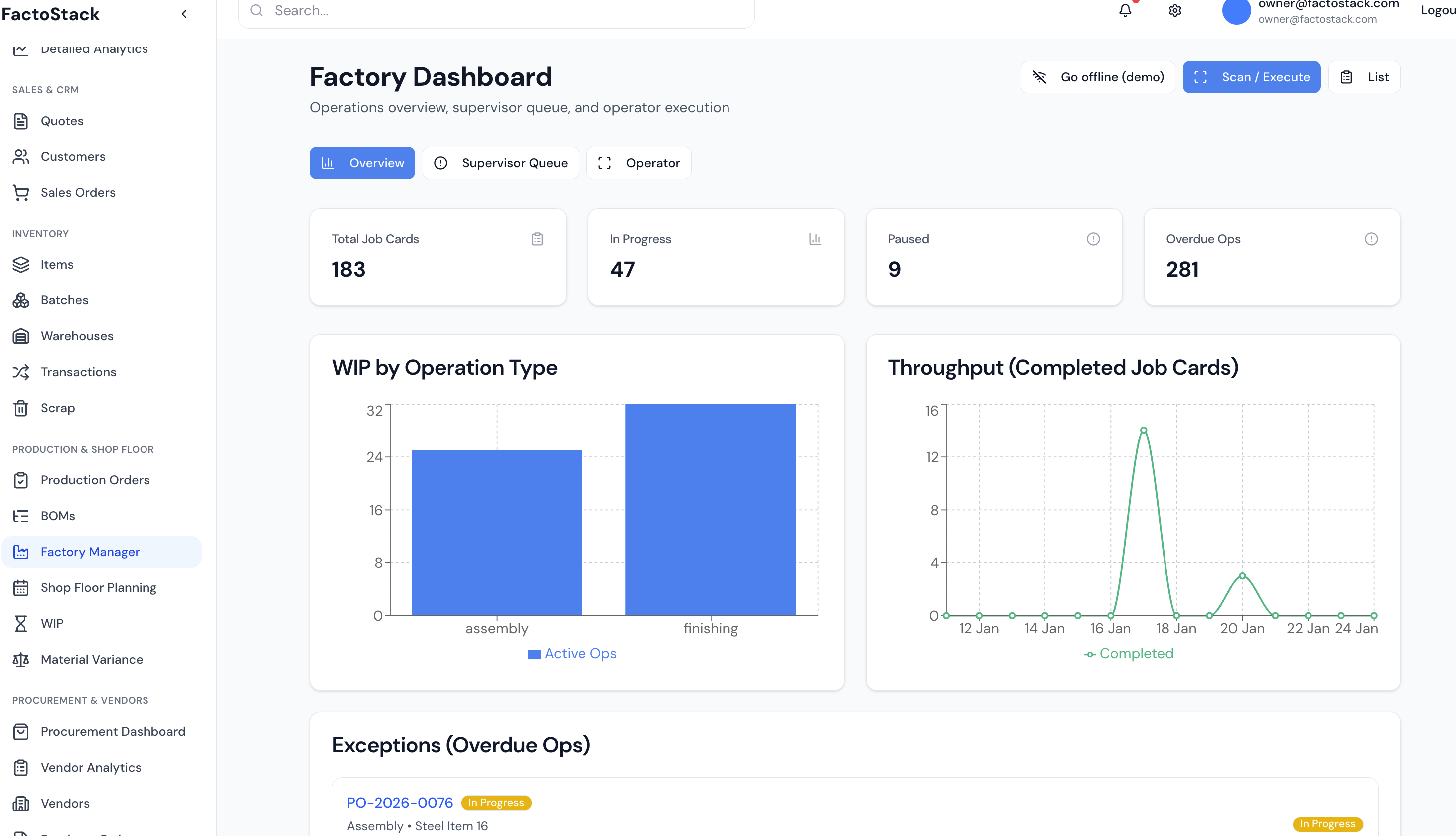
What Vendors Usually Sell
Most ERP sales conversations are built around breadth:
- number of modules
- number of reports
- number of integrations
- number of dashboards
- number of user roles
That sounds impressive, but none of it matters if your team still runs the factory through WhatsApp, Excel, and memory.
An MSME does not need fifty modules on day one. It needs control over the handful of processes that repeatedly create delays, leakage, and confusion.
What Manufacturers Actually Need
1. One clear flow from enquiry to invoice
The first requirement is not "advanced ERP." It is a dependable operating flow:
The core operating chain
If these steps are split across email, Excel, Tally, and phone calls, every handoff becomes a point of failure. Quantities change. Dates are missed. Accounts invoices the wrong version. Production starts without commercial confirmation.
The software should make this flow visible and linked, not force each team to re-enter the same information.
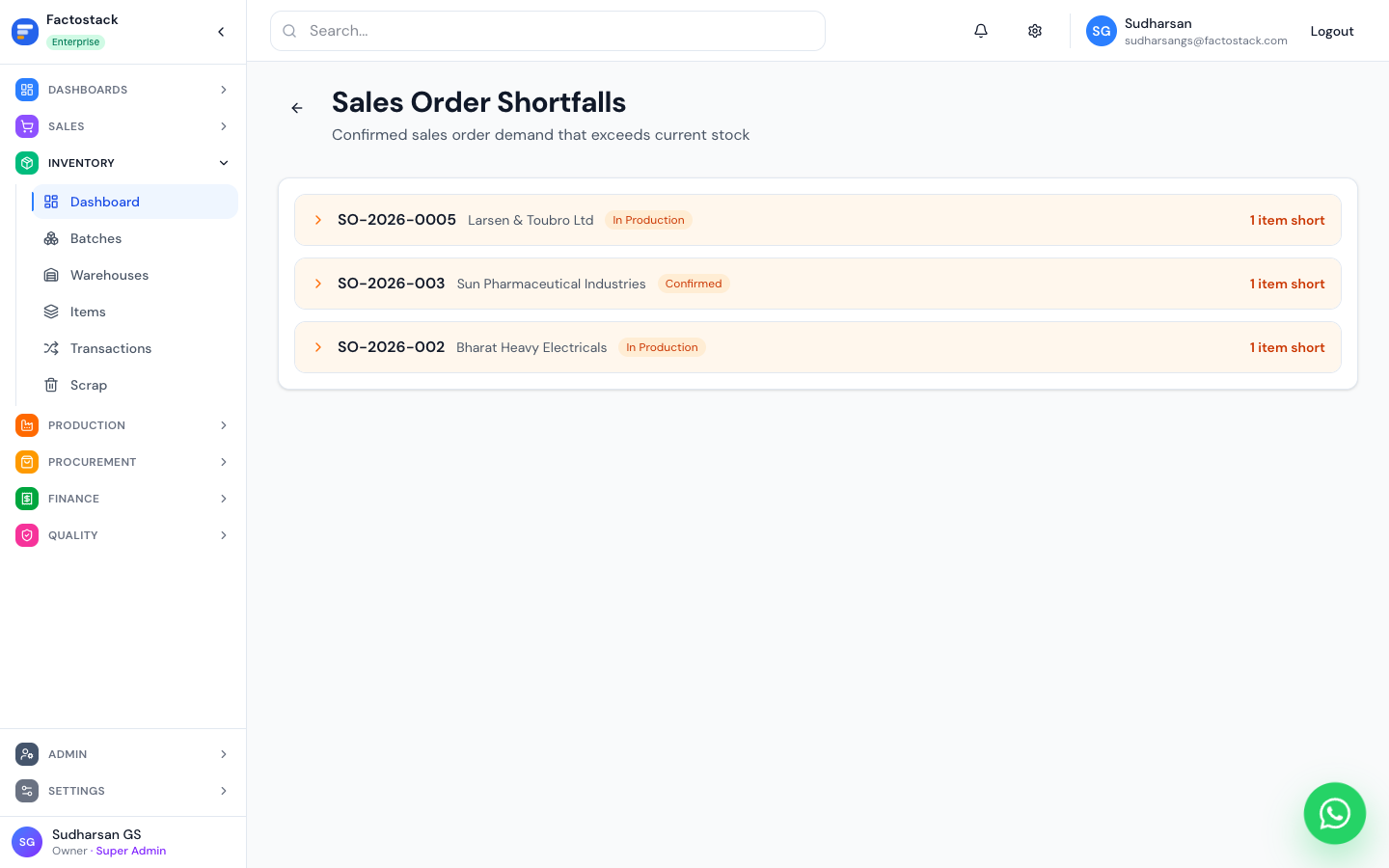
2. Real inventory visibility
Most factories do not suffer from a lack of inventory reports. They suffer from inventory numbers that cannot be trusted.
Manufacturers need to know:
- current stock by item and location
- reserved stock against open orders
- shortages against planned production
- incoming material against purchase orders
- rejected or blocked stock
If inventory only becomes accurate after a month-end physical count, the system is not helping the operation.
3. BOM and production order discipline
If a product is manufactured repeatedly, the system should know what goes into it. That means BOMs, planned quantities, material requirements, and actual production completion.
Without this, raw material deduction becomes manual, WIP becomes invisible, and costing becomes guesswork.
For many MSMEs, this is the turning point: the day they stop treating production as an informal process and start treating it as a controlled record.
4. Purchase follow-up that does not live in one buyer's head
Procurement is not finished when the PO is sent.
Manufacturers need:
- PO status
- promised delivery dates
- partial receipts
- GRN history
- vendor-wise pending material
- vendor payment visibility
If the only follow-up system is "call the supplier again," delays will always be discovered late.
5. Shop floor visibility without enterprise complexity
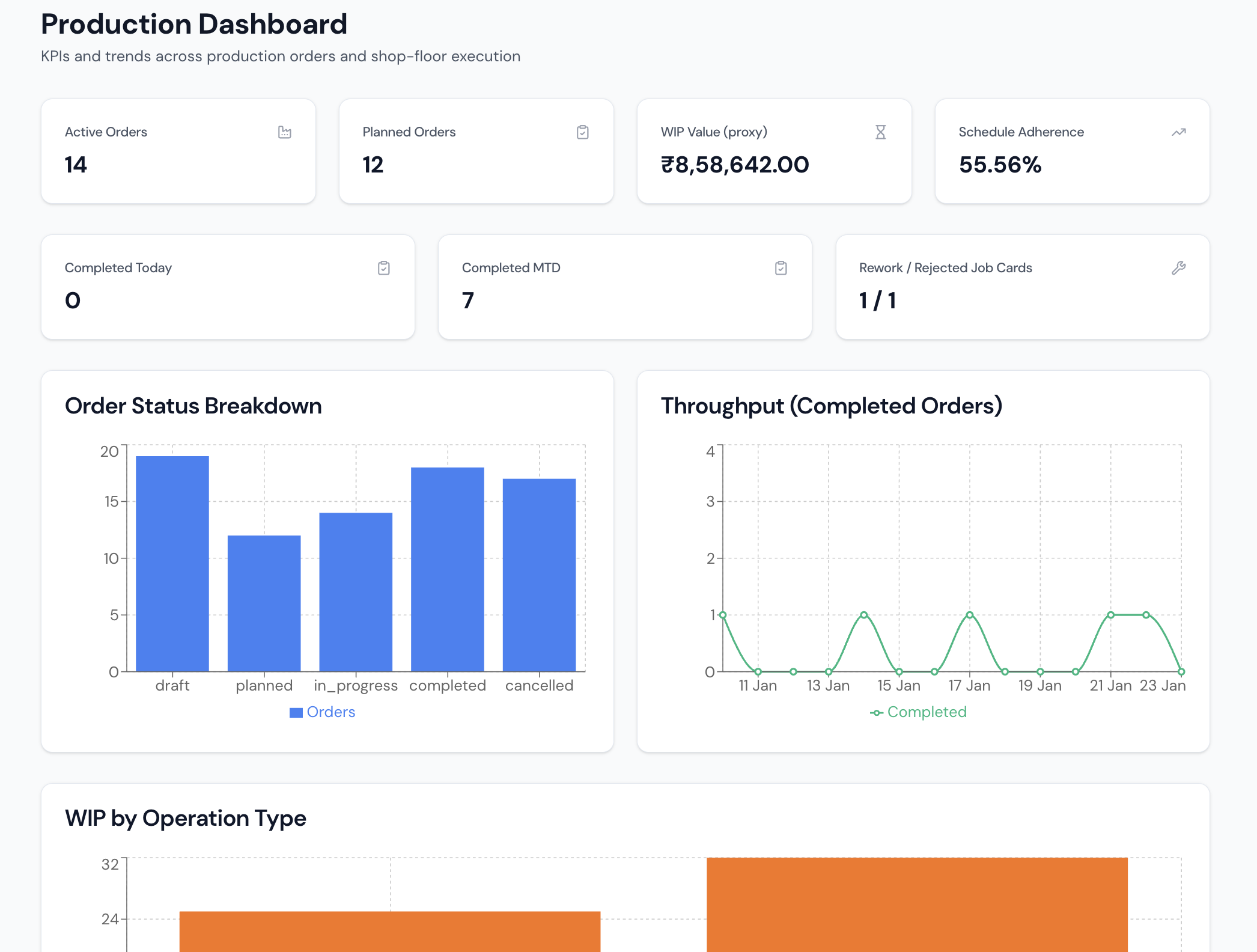
Small factories do not need a heavy MES rollout to benefit from shop floor tracking.
They need a simple answer to simple questions:
- which jobs are running
- which stage each job is in
- what has completed
- what is delayed
- what was rejected or reworked
Even a lightweight job-card workflow creates more value than a fancy dashboard with no production control behind it.
6. Tally-compatible accounting handoff
Most Indian MSMEs are not trying to replace Tally. They are trying to stop forcing Tally to run the factory.
That means the ERP should capture operations while keeping accounts comfortable:
- invoice data ready for posting
- purchase bill references intact
- GST fields preserved
- payment status visible
The right setup is often operations software plus Tally, not operations versus Tally.
What Manufacturers Usually Do Not Need First
This is where many implementations go off track. Factories get sold long-range capability before core process control exists.
You usually do not need these first:
- deep custom BI dashboards
- HR, payroll, and attendance in phase one
- complex workflow engines
- dozens of approval layers
- extensive custom fields everywhere
- highly customized reports before basic data discipline is in place
These can all be useful later. They are just not where most MSMEs should start.
A Better ERP Buying Checklist
When evaluating a system, ask these questions instead of asking how many features it has.
- Can the sales order become a production order without re-entry?
- Can the system show shortages before production starts?
- Can inventory be updated from purchases, production, and dispatch in one flow?
- Can we track partial completion, delay, and rejection?
- Can purchase receipts be matched against the original PO?
- Can accounts keep working in Tally if needed?
- Can the team learn the daily flow in under two weeks?
If the answer to these is weak, the polished demo is irrelevant.
The Practical Rollout Most MSMEs Should Use
The highest-success path is usually narrow and operational:
- item master and customer master
- quotes and sales orders
- inventory and warehouses
- BOMs and production orders
- procurement, GRN, and vendor follow-up
- dispatch and invoicing
Once the team is using these consistently, then expand into reporting, portals, field workflows, or finance integrations.
That sequence respects how factories actually change: process first, sophistication later.
Where FactoStack Fits
FactoStack is built around that narrower, more useful starting point.
It is designed for the work Indian manufacturers actually do every day:
- quotes, orders, and dispatch
- BOM-driven production planning
- purchase orders and GRNs
- inventory movement
- vendor and customer visibility
- Tally-compatible accounting handoff
That is different from trying to implement every imaginable module at once.
Manufacturing ERP for Indian MSMEs
Start with the workflows that run the factory: orders, inventory, procurement, production, dispatch, and invoicing.
Related Guides
- ERP versus Tally for small manufacturers
- 5 signs your factory has outgrown Tally
- How to run MRP without an SAP budget
Frequently Asked Questions
Choose ERP Around the Factory, Not the Demo
If your team is still coordinating orders, materials, and production through disconnected tools, the next useful step is not a broader demo. It is tighter operational control.

Written by
Sudharsan GS
Building FactoStack with Indian MSME manufacturers across inventory, production, dispatch, GST, and Tally workflows.