There is a pattern most Indian manufacturers know well:
The order book looks healthy. Production is running. Invoices are going out. But the bank balance never feels comfortable.
Vendor payments are due. Salaries need to go out. Raw material needs to be purchased for the next batch. And the customer who owes Rs 8 lakhs says they will pay "next week."
This is not a business problem in the traditional sense. Sales are fine. Margins are acceptable. The problem is timing.
Working capital is the money a factory needs to keep running between the moment it spends on materials and the moment it collects from customers. For most manufacturers, that gap is where the pressure lives.
How Working Capital Works in Manufacturing
Working capital in a factory is driven by three cycles:
1. The inventory cycle
You buy raw materials, store them, convert them into work-in-progress, convert that into finished goods, and eventually dispatch.
At every stage, money is locked:
- raw material sitting in the store
- WIP on the shop floor
- finished goods waiting for dispatch or quality approval
- packaging material
- consumables
The longer material sits at any stage, the more cash is locked.
2. The receivables cycle
After you dispatch and invoice, the customer takes time to pay.
In Indian manufacturing, payment terms of 30, 45, 60, or even 90 days are common. Some industries run on 120-day credit cycles.
That means the factory has already spent on material, labour, power, and overhead, but the cash from that sale will not arrive for weeks or months.
3. The payables cycle
Vendors who supply raw materials also give payment terms. If you can pay your vendor in 45 days but collect from your customer in 60 days, you are funding a 15-day gap.
If the vendor demands payment in 15 days and the customer takes 90 days, that gap is 75 days. The factory funds that entirely from its own capital or from borrowed money.
The Cash Conversion Cycle
The cash conversion cycle (CCC) is a simple formula that captures this timing problem:
CCC = Inventory Days + Receivable Days - Payable Days
Example:
| Component | Days |
|---|---|
| Average inventory holding period | 45 days |
| Average customer payment period | 60 days |
| Average vendor payment period | 30 days |
| Cash conversion cycle | 75 days |
This means the factory funds 75 days of operations before cash comes back. For a factory spending Rs 10 lakhs per month on materials and operations, that is roughly Rs 25 lakhs permanently locked in the cycle.
What makes CCC worse for manufacturers
- Slow-moving inventory. Material bought for one order sits unused because the customer delayed or changed specs.
- Unplanned purchases. Urgent material at higher cost because planning was not done early enough.
- Late invoicing. Goods are dispatched but the invoice goes out 3 to 5 days later, pushing the collection date further.
- Weak follow-up. Nobody tracks which invoices are overdue until the owner asks.
- Customer concentration. One large customer paying late affects the entire cash flow.
Where Cash Gets Stuck in a Factory
Raw material overstock
Factories often overbuy because:
- bulk discounts seem attractive
- vendor minimum order quantities are high
- the purchase team buys "just in case"
- there is no reliable way to check what is already in stock
Result: material worth weeks of production sits in the store, tying up cash.
Work-in-progress delays
WIP becomes a cash trap when:
- production orders stall waiting for one missing component
- quality issues cause rework
- subcontracted work comes back late
- production priorities keep changing
Every day a half-finished product sits on the shop floor, cash is locked with no revenue to show for it.
Finished goods not dispatched
Finished goods may be ready but not shipped because:
- the customer has not confirmed the dispatch date
- packaging material is not available
- transport is not arranged
- the invoice has not been prepared
- quality approval is pending
This is cash waiting at the last stage before conversion.
Invoices not followed up
Many MSME manufacturers do not have a structured payment follow-up process. The accountant checks Tally periodically, but there is no system that:
- flags invoices approaching their due date
- sends payment reminders
- escalates overdue accounts
- tracks partial payments against specific invoices
Without this, receivables age quietly, and the factory compensates by borrowing or delaying its own vendor payments.
Five Practical Ways to Improve Working Capital
1. Reduce inventory days
- Buy closer to actual production needs instead of forecasting loosely
- Use BOM-based material planning so procurement is tied to confirmed orders
- Track slow-moving items and stop reordering them
- Set reorder points based on actual consumption, not guesswork
Even reducing average inventory from 45 days to 30 days frees up significant cash.
2. Invoice faster
- Generate the invoice on the day of dispatch, not days later
- Automate invoice creation from the dispatch record
- Send the invoice digitally on the same day
Every day between dispatch and invoice is a free loan to the customer.
3. Follow up on receivables systematically
- Know exactly which invoices are due this week, next week, and overdue
- Set up a weekly review of the debtor aging report
- Contact customers before the due date, not after
- Track payment promises and hold people accountable
A simple debtor aging report, reviewed weekly, can recover lakhs in stuck receivables. Most factories are surprised by how much is overdue when they first run the numbers.
4. Negotiate vendor terms deliberately
- Ask for longer payment terms with reliable vendors
- Offer early payment discounts only when cash is genuinely surplus
- Stagger payment dates across vendors so cash outflow is predictable
- Avoid prepayment unless the discount justifies the cash cost
5. Track the cash conversion cycle monthly
Calculate CCC every month. See if it is improving or getting worse. A factory that tracks this number usually finds specific, fixable bottlenecks within 2 to 3 months.
Measure
Calculate your current cash conversion cycle: inventory days + receivable days minus payable days.
Identify the biggest gap
Is cash stuck in raw material, WIP, finished goods, or unpaid invoices? Find the largest bucket first.
Fix the process
Tighten procurement planning, speed up invoicing, start weekly payment follow-up, or negotiate better vendor terms.
Track monthly
Review CCC every month. Small improvements in each area compound into meaningful cash relief.
Working Capital and Lending
For MSME manufacturers who need external working capital, banks and NBFCs look at:
- consistency of orders (do you have predictable revenue?)
- debtor aging (how old are your receivables?)
- inventory health (is stock turning or piling up?)
- GST filing regularity (are you compliant and filing on time?)
- bank statement patterns (is cash flow stable?)
A factory that can show structured data on these signals is in a stronger position to negotiate better rates and limits. This is where operational software becomes a financial asset, not just an admin tool.
Where FactoStack Fits
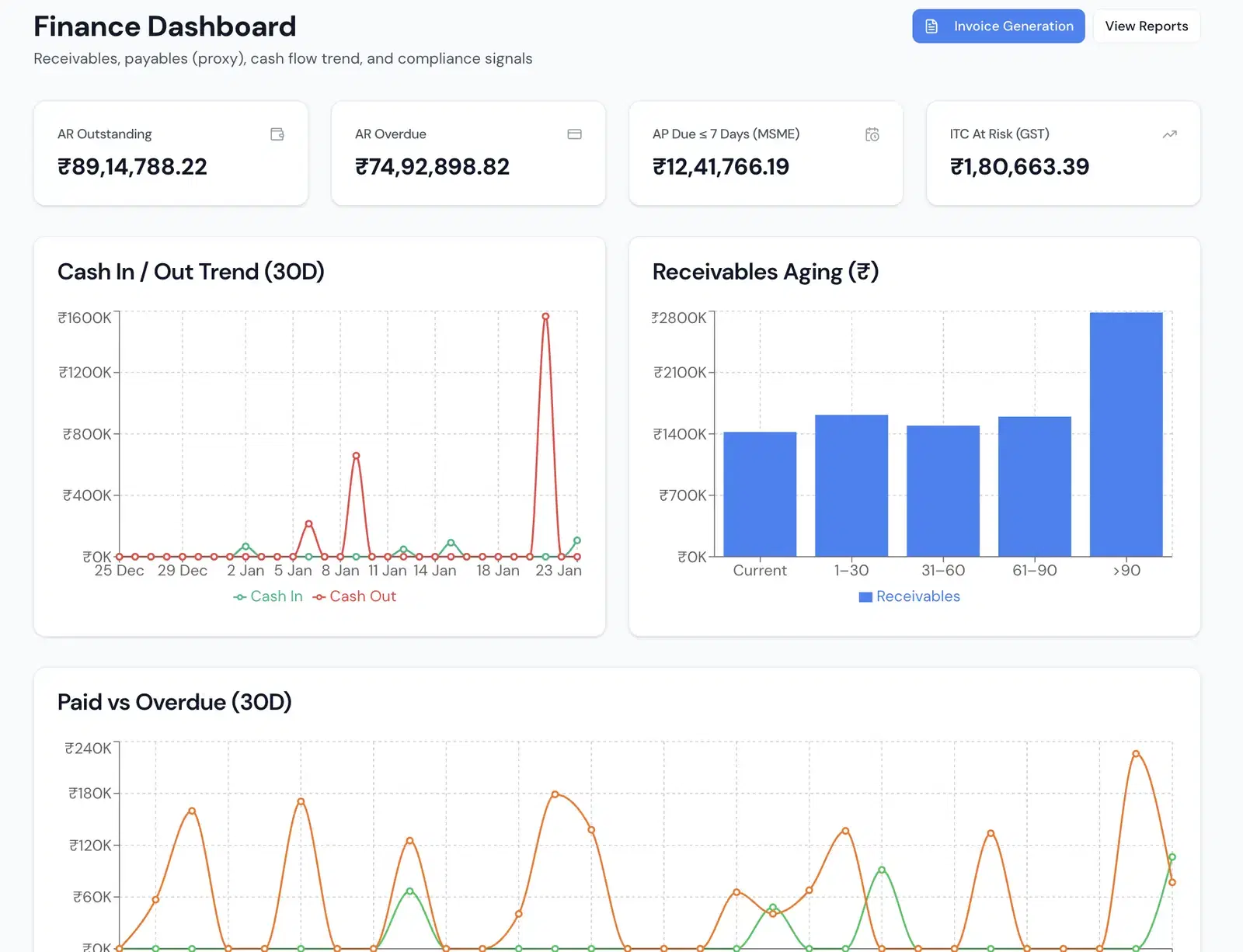
FactoStack connects the operational data that drives working capital: sales orders, production, inventory, dispatch, invoicing, and payment follow-up. Instead of checking stock in one system, invoices in another, and chasing payments on WhatsApp, the factory gets one view of where cash is locked and where it can be freed.
Working Capital Visibility for Manufacturers
See your receivables, payables, inventory, and cash conversion cycle in one place. Identify where cash is stuck and take action before it becomes a crisis.
Related Guides
- Debtor aging report for manufacturers
- Your factory data is your credit score
- Why 90% of Indian manufacturers run on 3 disconnected tools
- What Indian manufacturers actually need from an ERP
Frequently Asked Questions
Cash Flow Is an Operational Problem, Not Just a Finance Problem
The accounts team cannot fix working capital alone. The root causes are in procurement, production, dispatch, and customer management. When those processes are visible and connected, cash moves faster. When they are fragmented across Tally, Excel, and WhatsApp, money stays stuck.
The fix is not more capital. It is better visibility into where capital is already locked.

Written by
Sudharsan GS
Building FactoStack with Indian MSME manufacturers across inventory, production, dispatch, GST, and Tally workflows.