
Visit enough Indian factories and you start seeing the same software architecture again and again:
- Tally for accounts
- Excel for planning
- WhatsApp for coordination
None of these tools are bad on their own. The problem is that together they create a business that runs on repeated re-entry, verbal follow-up, and conflicting versions of reality.
That is why many manufacturers feel busy all day and still end the week unsure which orders are delayed, which materials are short, and which customers are actually ready for dispatch.
Why These Three Tools Became the Default
The stack exists for understandable reasons.
Tally is trusted
Accounts teams know it. CAs know it. GST workflows are familiar. For accounting, Tally is still the default comfort zone.
Excel is flexible
If something is missing, the team can create a new column today. No vendor ticket. No implementation cycle. No waiting.
WhatsApp is immediate
It gets a response faster than email. Customers reply there. Vendors reply there. Supervisors already use it.
In other words, this stack is not irrational. It is the fastest way to get a young or growing factory operational. The issue is what happens when order volume grows.
Where the Disconnect Starts Hurting
The first few problems usually look small:
- the Excel order tracker does not match the latest customer change on WhatsApp
- the dispatch team invoices an old quantity
- purchase follows up with the vendor, but production does not know the revised delivery date
- accounts has stock in Tally, but the shop floor says material is not available
Each incident feels like a people problem. Over time you realise it is a system problem.
What Each Tool Knows and What It Does Not
| Tool | Usually used for | What it misses |
|---|---|---|
| Tally | accounting, invoicing, GST, ledgers | live production status, order execution, real material flow |
| Excel | order planning, stock lists, follow-up sheets | controlled workflow, audit trail, shared real-time updates |
| customer approvals, vendor follow-up, internal coordination | structured records, version control, searchable operations history |
No single tool holds the full flow. So every team works from a partial picture.
The Five Operational Costs of Disconnected Tools
1. Duplicate data entry
The same order may be typed into a quotation sheet, a planning sheet, a WhatsApp message, a dispatch file, and then Tally.
Each re-entry is a chance for:
- wrong quantities
- wrong item codes
- wrong dates
- missed revisions
The cost is not just clerical time. It is the error rate created by clerical repetition.
2. No reliable "current status"
When someone asks, "What is the status of this order?", the answer often depends on whom you ask:
- sales gives the customer promise date
- production gives the current shop floor reality
- purchase gives the material dependency
- accounts gives the invoiced position
If four teams can all be correct from their own point of view, then the business does not have one operational truth.
3. Inventory drift
Excel may show planned consumption. Tally may show book stock. WhatsApp may contain the latest emergency issue to production.
When these are not connected:
- shortages are discovered late
- buying becomes reactive
- WIP is hard to trust
- month-end reconciliation becomes painful
This is one reason factories feel "stock is there but not there."
4. Delay discovery happens too late
In a disconnected setup, delays surface only when somebody manually joins information from multiple places:
- customer order date
- material arrival status
- production completion status
- dispatch readiness
If those signals do not meet in one system, the delay is usually discovered when the customer is already following up.
5. Managers become human APIs
The owner, operations head, or senior coordinator ends up stitching everything together manually.
They become the person who knows:
- which Excel file is current
- which WhatsApp confirmation matters
- which PO is really late
- which dispatch should be prioritised
That works until the business depends too much on one person's memory and availability.
Why Factories Stay in This Setup for So Long
Because the stack fails gradually, not dramatically.
There is no single day when Tally, Excel, and WhatsApp stop working. Instead:
- follow-up load increases
- planning quality falls
- exceptions multiply
- leadership spends more time chasing than deciding
It feels like growth pain. Often it is architecture pain.
What a Better Setup Actually Looks Like
Manufacturers do not necessarily need to replace every familiar tool.
A practical improvement usually looks like:
- keep Tally for accounting and GST
- move quotations, orders, inventory, production, procurement, and dispatch into one operations workflow
- keep WhatsApp as a communication channel, not the primary record
That structure gives the factory one source of operational truth without forcing the accounts team to change everything at once.
What should be unified first
The Signal That You Have Outgrown the Three-Tool Stack
You have outgrown it if simple questions require cross-checking three people and two files:
- can we dispatch this order this week
- do we have the required material
- which jobs are delayed right now
- which vendor is holding up production
- what quantity should accounts invoice
At that point, the problem is not that your team is careless. The problem is that your software stack was never designed to operate as one system.
Where FactoStack Fits
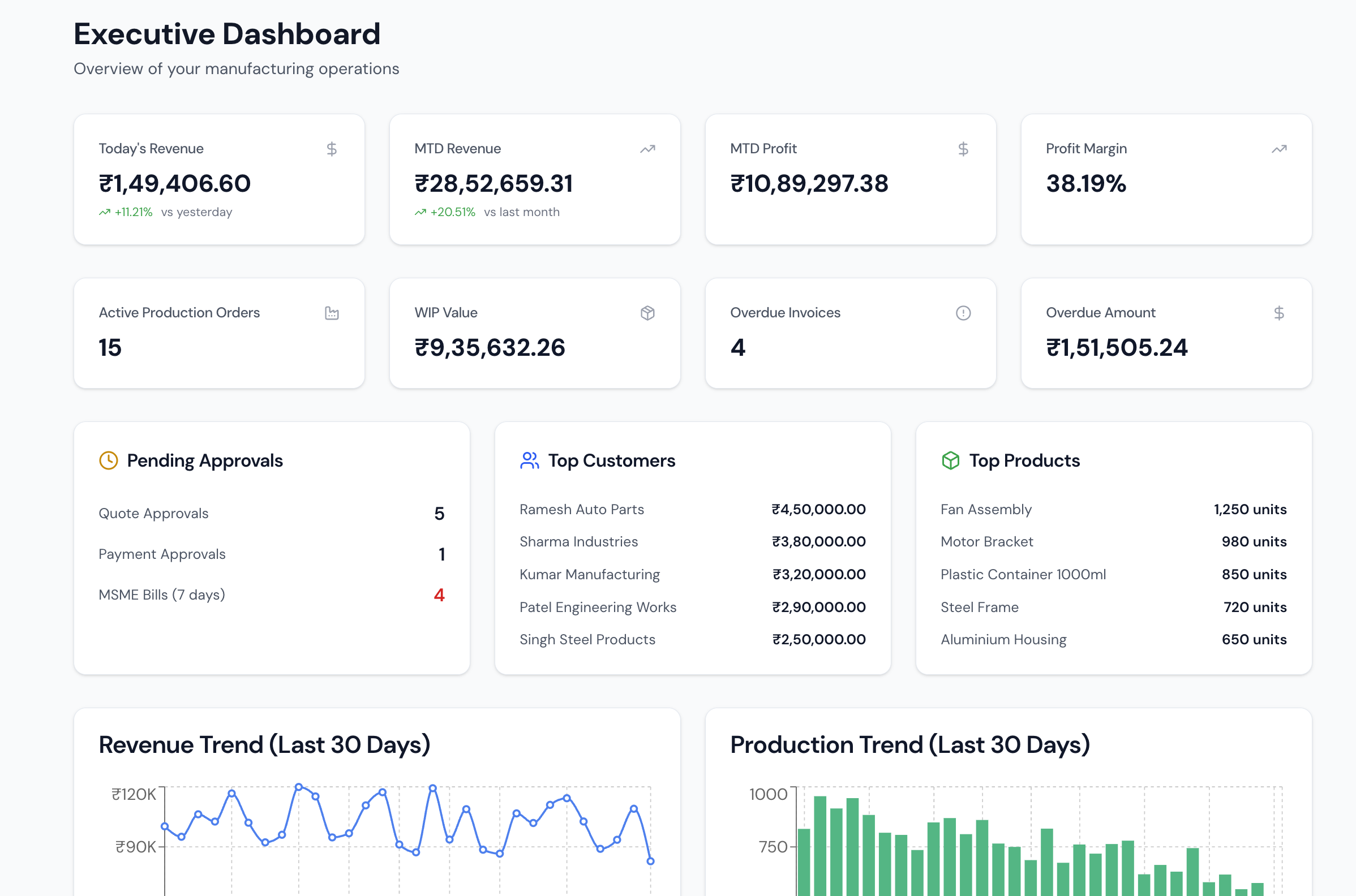
FactoStack is designed to replace the disconnected operational layer while still coexisting with Tally.
That means:
- sales orders feed production
- production updates inventory
- procurement stays linked to shortages
- dispatch and invoice quantities stay aligned
- accounts can still continue in Tally
One Operating System for Factory Workflows
Unify quotations, orders, production, inventory, procurement, dispatch, and invoicing while keeping Tally for accounting if needed.
Related Guides
- 5 signs your factory has outgrown Tally
- What Indian manufacturers actually need from an ERP
- How to track purchase orders, GRNs, and vendor payments
Frequently Asked Questions
Replace the Gaps, Not Necessarily the Whole Stack
Most factories do not need to jump from Tally and Excel straight into a heavy enterprise ERP. They need one controlled operational flow where daily work stops leaking across disconnected tools.

Written by
Sudharsan GS
Building FactoStack with Indian MSME manufacturers across inventory, production, dispatch, GST, and Tally workflows.