Your purchase team probably answers the same questions every week:
- Did you send the purchase order?
- Is the delivery date still the same?
- Have you received our material?
- Why was this lot rejected?
- Did accounts approve our bill?
- When will payment be released?
None of these questions is difficult. The problem is volume.
When every update needs a call, WhatsApp message, or email, buyers become human status dashboards. Suppliers wait for answers, internal teams get interrupted, and important exceptions get buried inside routine follow-up.
A vendor self-service portal gives both sides one shared operational record.
What a Vendor Portal Is — and Is Not
A vendor portal is a secure workspace where each supplier can access only their own transactions and actions.
It can allow a vendor to:
- view and acknowledge purchase orders
- confirm or propose delivery dates
- update dispatch details
- upload invoices, test certificates, and other documents
- see goods-receipt and quality status
- respond to shortages or rejections
- check invoice verification and payment status
- maintain selected company and bank details through an approval flow
It is not a public dashboard and should not expose internal commercial discussions, other vendors, margins, or private notes.
The objective is simple: move routine coordination from scattered conversations into a controlled, searchable workflow.
Where the Time Savings Come From
Purchase-order acknowledgement
Email proves that a PO was sent. It does not prove that the supplier accepted the quantity, price, specification, and date.
In a portal, the vendor can acknowledge the PO, flag a difference, or propose another delivery date. Purchase sees the exception immediately instead of discovering it a couple of days before production needs the material.
Delivery updates
Vendors can record the quantity shipped, expected arrival date, transporter, vehicle, LR or docket number, and packing details.
Stores gets advance visibility. Purchase stops calling for status. Production can plan around a confirmed shipment rather than a vague promise.
Document collection
Invoices, test certificates, certificates of analysis, packing lists, and compliance documents often arrive through different channels.
Uploading them against the relevant PO or shipment makes them easier to verify and retrieve. It also reduces the familiar request: “Please send that document again.”
Receipt and quality visibility
The vendor should be able to see whether material was received, accepted, rejected, or held for inspection.
If there is a rejection, show the affected item, quantity, reason, and requested action. Keep photos or inspection evidence with the issue so both sides discuss the same facts.
Invoice and payment status
Suppliers call because silence creates uncertainty.
Useful statuses such as received, under verification, approved, scheduled, part paid, paid, or on hold reduce unnecessary follow-up without exposing internal bank or cash information.
The portal should also show a clear reason and contact path when an invoice is on hold.
PO shared
The supplier receives the order in one secure workspace and acknowledges the terms.
Date confirmed
The vendor accepts the requested date or proposes a change for buyer review.
Shipment updated
Quantity, transporter, reference number, and documents are added before arrival.
Receipt visible
The supplier sees received, accepted, rejected, or held quantities.
Payment tracked
Invoice verification and payment status remain visible without repeated calls.
The Minimum Useful Vendor Portal
Do not begin with every possible supplier-management feature. A focused first version should handle the highest-frequency coordination.
| Area | Vendor action | Internal benefit |
|---|---|---|
| Purchase orders | View and acknowledge | Confirm that terms were received and accepted |
| Delivery dates | Confirm or request change | Find supply risks earlier |
| Dispatch | Add quantity and transport details | Prepare stores and production |
| Documents | Upload against PO or shipment | Keep records in the right context |
| Quality | View and respond to issues | Shorten rejection resolution |
| Invoices | Check verification status | Reduce accounts follow-up |
| Payments | View simple payment status | Reduce routine calls |
Once vendors use these reliably, add features such as forecasts, rate requests, scorecards, onboarding, or compliance expiry reminders.
Design It for the Vendor, Not Only for Your Team
Many supplier portals fail because they make the vendor perform extra data entry while the buyer continues using another internal system.
Good adoption requires:
- Mobile-first access. Many small suppliers will respond from a phone, not a desktop.
- Simple sign-in. Avoid repeated password resets and complicated onboarding.
- Clear actions. “Confirm delivery date” is better than a dense transaction screen.
- Low duplication. Reuse PO data and ask the vendor only for information they own.
- Useful notifications. Alert vendors when action is needed, not for every status change.
- Fast support. Give vendors a clear contact when a dispute cannot be resolved in the portal.
The portal must save the supplier time too. Otherwise, they will continue sending WhatsApp messages and ask your buyer to update the system for them.
Keep Permissions and Approvals Tight
Self-service does not mean unrestricted editing.
Define exactly what a vendor can view, submit, or request:
- A vendor sees only their own organisation and transactions.
- PO quantities, rates, and terms cannot be silently changed.
- Delivery-date changes require buyer review when they affect planning.
- Bank-detail changes trigger verification and approval.
- Uploaded documents keep their history.
- Internal notes and evaluation scores remain private.
- Users can be removed when a vendor employee leaves.
Maintain an audit trail of important actions such as PO acknowledgement, bank-detail requests, date changes, and document replacement.
A Practical Rollout Plan
1. Choose a narrow pilot
Start with five to ten active vendors who create a meaningful amount of follow-up. Include a mix of comfortable and less technical users.
2. Pick one complete workflow
PO acknowledgement and delivery confirmation is a strong starting point. It is frequent, easy to understand, and valuable to planning.
3. Make internal ownership clear
Decide who responds when a vendor proposes a new date, disputes a receipt, or asks about a payment hold. A portal without internal response discipline only creates a new inbox.
4. Train with a real transaction
Use an actual PO on the vendor's phone. Show the complete action in a few minutes and provide a short reference in the language they prefer.
5. Measure adoption and exceptions
Review:
- percentage of POs acknowledged in the portal
- delivery dates confirmed before due date
- vendor documents attached to the correct transaction
- status calls or messages before and after rollout
- unresolved vendor actions
- time taken to close a quality issue
6. Expand only after the internal system is connected
Portal updates should change the operational record used by purchase, stores, quality, and accounts. If staff must copy portal data into Excel, the manufacturer has added another disconnected tool.
What Should Stay Human
A portal is excellent for status, records, and routine action. It should not replace relationships.
Keep people involved in:
- price and contract negotiation
- urgent shortage resolution
- new product or specification discussion
- recurring quality problems
- supplier-development plans
- sensitive payment disputes
The portal clears routine traffic so those conversations get more attention.
Where FactoStack Fits
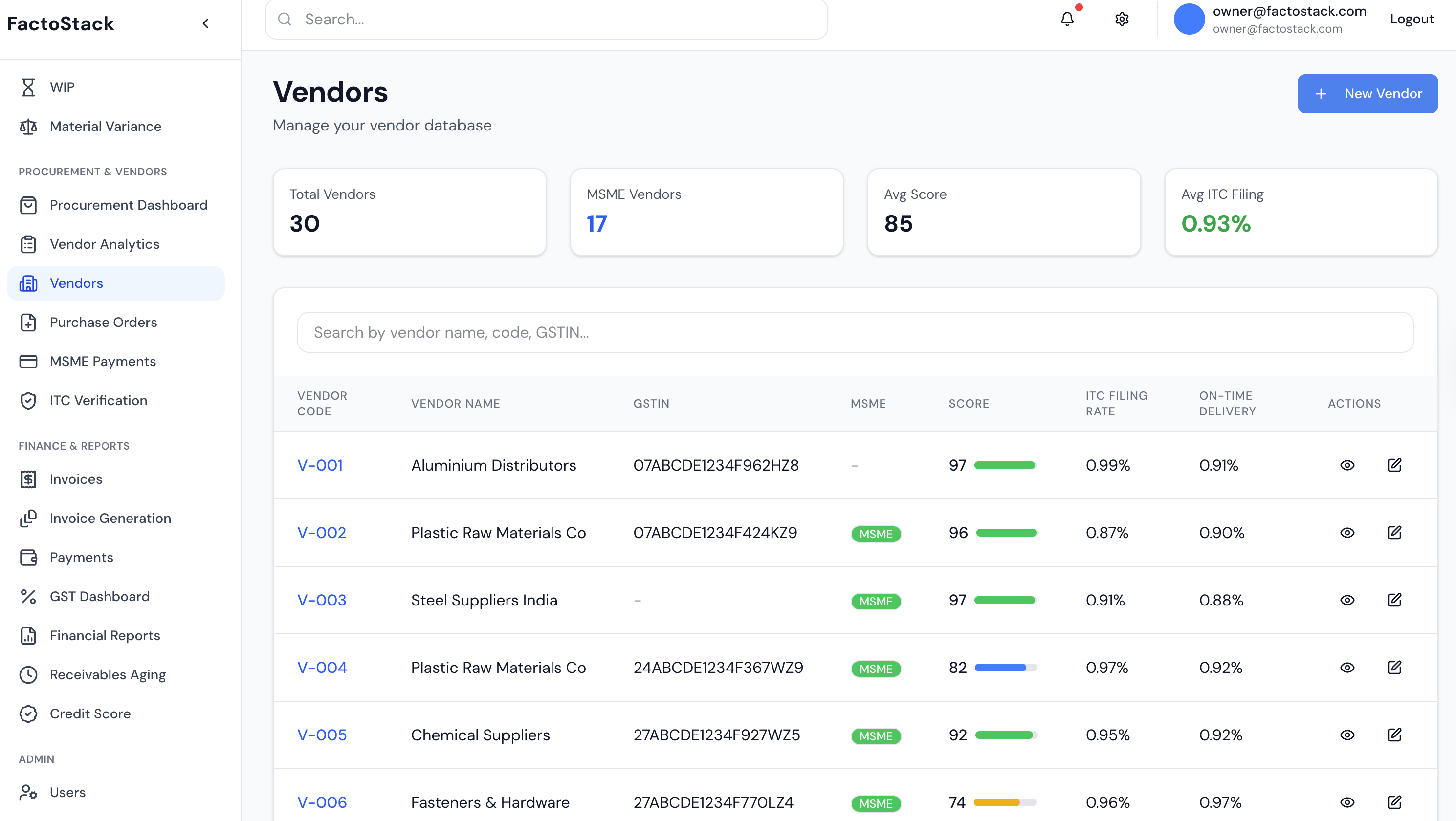
FactoStack's vendor workflow connects supplier-facing actions with purchase orders, receipts, quality, documents, invoices, and payment context. Vendors get a simple place to respond, while internal teams keep control of approvals and private information.
Vendor Self-Service Portal
Let suppliers confirm orders, share delivery updates, upload documents, respond to quality issues, and check commercial status without repeated calls.
Related Guides
- How to track purchase orders, GRNs, and vendor payments
- Why manufacturers run on disconnected tools
- The hidden cost of running your factory on WhatsApp
- How to run MRP without an SAP budget
Frequently Asked Questions
Give Vendors Answers Without Making Them Ask
Supplier collaboration breaks down when every update depends on finding the right person at the right time.
A focused vendor portal creates a shared record for orders, dates, documents, quality, and payment status. The result is not less supplier communication. It is less repetitive communication and more time for the exceptions that actually need attention.

Written by
Sudharsan GS
Building FactoStack with Indian MSME manufacturers across inventory, production, dispatch, GST, and Tally workflows.